Agents
An agent in Agenta is built for one job. This page covers what an agent is made of, how its instructions work, and why one shared context window shapes every other choice.
An agent you build, not one you are given
ChatGPT gives you a prebuilt general agent. It already works, for everything, the moment you open it.
Agenta gives you an empty one. The instructions start blank and you fill them with the job you want done. A general agent knows a little about everything and nothing about your company, your customers, or how you want the work done. An agent you build knows one job.
So the first decision in Agenta is not which model to use. It is what the agent is for: reviewing inbound support tickets and drafting replies, keeping the changelog current, acting as a marketing coworker. That answer decides the instructions, tools, skills, and files you give it.
You do not fill in forms to build one. You chat with the agent and it configures itself as you talk. Build your first agent walks through it.
What an agent is made of
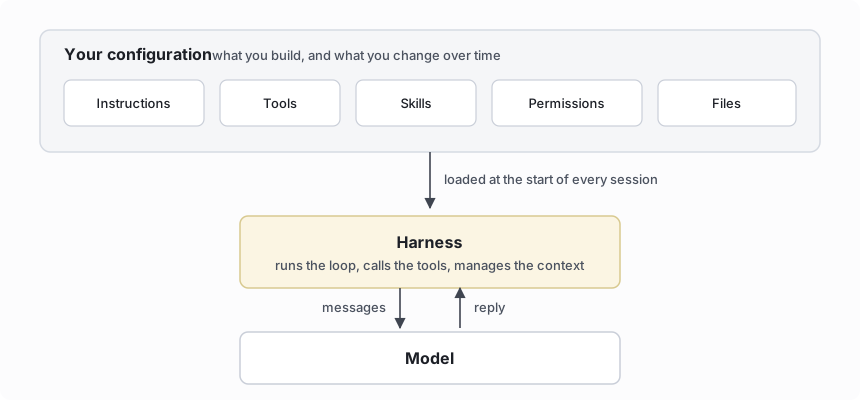
A configuration. The instructions, the tools it can call, the skills it can load, and the permissions that decide what it may do on its own. This is the part you build, and it is versioned, so every change has a history. The files an agent reads and writes live in its folder alongside the configuration rather than inside it. See Sessions and versions.
A harness. The program that drives the model. It sends the messages, runs the tool calls the model asks for, feeds the results back, and manages the context window as the conversation grows. Agenta ships with Claude Code and Pi.
A model. A large language model does one thing: you send it messages and it returns a message. Everything else, tool calls included, is the harness acting on what the model said.
Harness and model are separate choices, and changing either one does not mean rebuilding the agent. See Harnesses and models.
Instructions
The instructions are the agent's identity. Harnesses usually call this the system prompt. In Agenta they live in a file named AGENTS.md, and they are the first thing sent to the agent at the start of every session.
They are part of the agent rather than something you attach to it. An agent with no instructions is a general assistant. The instructions are what make it yours.
What goes in them
Context about the work. For a marketing agent that means who you are, what the company sells, who the customers are, how you want the agent to talk to you, and the problems you want help with.
That content belongs in the instructions rather than in a file because the instructions come with a guarantee. They are sent at the start of every session, so the agent always has them. A file in the workspace is read only if the agent decides to go and read it.
So context that has to be present every time goes in the instructions. Reference material the agent can look up when the moment comes goes in a file. See Files and knowledge.
Instructions are resent on every turn
A turn is one call to the model. Everything in the instructions goes to the model again on every turn of every session, and a single request from you often takes several turns. A long identity is not a one-time cost. It is a recurring bill, paid each time the agent thinks.
That is the tension. More context makes the agent better at the job, and it also makes every turn more expensive and leaves less of the context window for the work itself. The consequence is that instructions hold what must be present every turn, and everything else lives in a skill or a file.
How instructions grow
In practice they start short: a few lines saying what the agent is for and who it works with.
Then they grow one line at a time, against real failures. The agent answers a customer in the wrong tone, so a line about tone goes in. It pulls numbers from the wrong dashboard, so the right one gets named. After a few weeks the instructions describe the job accurately, because each line was written the moment the agent got something wrong rather than guessed in advance.
Most instructions end up saying how the agent should talk. Left alone, an agent tends to write long and to restate the question before answering it. If you want short answers with no preamble, that goes in writing.
Write your agent's instructions covers the writing itself.
One budget: the context window
The model reads a fixed amount of text per turn. Instructions, tool descriptions, skills, files, and the conversation so far all draw on that same window. This single constraint explains the shape of everything else in Agenta.
- Instructions are always loaded. They are sent every turn, so they stay short.
- Tools cost a little, always. Each tool the agent has puts its name and description in every turn. See Tools and integrations.
- Skills load on demand. Until the agent needs one, it sees only a name and a description, so an agent can carry many. The description is what decides whether a skill fires. See Skills.
- Files are read on demand. Nothing is loaded until the agent opens the file, so a knowledge folder can grow without adding to every turn. See Files and knowledge.
One pattern follows from this: the instructions work as a map to everything else. A single line such as "the style guide is in writing/style.md, read it before drafting" spends a few always-loaded tokens and buys a whole document that costs nothing until it is needed.
The rest of an agent
- Skills give the agent a handbook for one kind of task, loaded when it is relevant.
- Tools and integrations give it actions it can take in other systems.
- Permissions decide which of those actions it takes on its own and which wait for your approval.
- Files and knowledge cover the folders an agent reads and writes, and which of them survive a session.
- Automations run an agent on a schedule or when an event happens in a connected app.
- Cost and usage covers what you are charged for.